
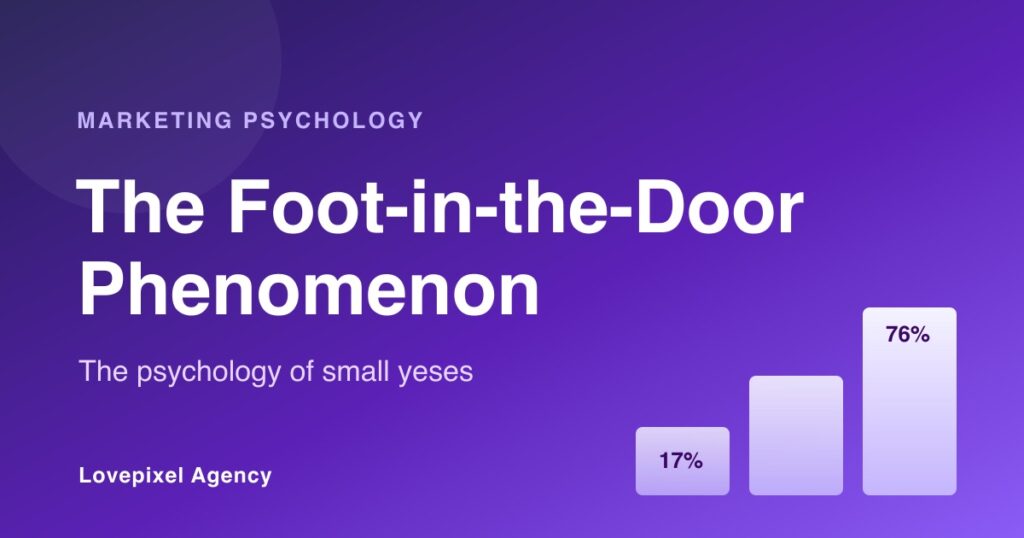
The foot-in-the-door phenomenon is a persuasion pattern where agreeing to a small request makes a person far more likely to say yes to a larger one later. Psychologists Jonathan Freedman and Scott Fraser demonstrated it in 1966: people who first agreed to a tiny favor complied with a much bigger ask 76% of the time, compared to just 16.7% of people asked cold. It works because a small yes shifts how we see ourselves, and we like to stay consistent with that new self-image.
Key takeaways
- A small initial commitment reshapes self-perception, and people act to stay consistent with it.
- Freedman and Fraser (1966) recorded 76% compliance in the strongest small-request group versus 16.7% in the control.
- The effect is real but conditional. Burger’s 1999 review found it can also do nothing or backfire.
- In marketing it shows up as micro-commitments: multi-step forms, free opt-ins, and staged checkouts.
- Used consciously, it lowers pressure. Used as a dark pattern, it erodes the trust it depends on.
What is the foot-in-the-door phenomenon?
The foot-in-the-door phenomenon is a compliance technique. You start with a request so small it is easy to accept, then follow it with the larger request you actually wanted. Because the person already said yes once, the second yes feels natural rather than forced. The name comes from door-to-door selling, where a salesperson who got a literal foot in the doorway had a much better chance of making the sale.
The standard definition is simple: a person who complies with a small first request becomes more likely to agree to a later, more significant request they would have refused if asked outright. It is one of the most studied ideas in social psychology, and it quietly powers a large share of modern marketing.
The study that started it: Freedman and Fraser (1966)
The phenomenon was established by Jonathan Freedman and Scott Fraser in their paper “Compliance without pressure: the foot-in-the-door technique,” published in the Journal of Personality and Social Psychology in 1966. They ran two field experiments with real homeowners in California, and the results still hold up as a textbook demonstration.
Experiment one: the household survey
Researchers first asked homeowners a small favor: answer a few questions about the soaps they used at home. Days later, the same people got a much larger request, to let a team of five men into their home for two hours to catalog every product they owned. More than 50% of the people who had agreed to the small survey said yes to the invasive second request. Among people approached cold with only the large request, fewer than 25% agreed. The small first yes roughly doubled compliance.
Experiment two: the “Drive Carefully” sign
The second study is the one most people remember. Homeowners were asked to place a small, tidy sign in a window supporting safe driving. Two weeks later, they were asked to put a large, poorly lettered “Drive Carefully” sign on their front lawn, one that partly blocked the view of the house. In the strongest condition, where the small and large asks were closely related, 76% agreed to the big ugly sign. In the control group, asked only the large request with no small step first, just 16.7% said yes.
A note on that headline number, because it is often misused. The 76% figure is the best single condition, where the two requests matched in issue and format. Across all four experimental groups, compliance ranged from about 45% to 76%. The honest summary is that more than 55% of experimental subjects agreed versus under 20% of controls. Even the conservative version is a large, reliable jump.
Why does the foot-in-the-door effect work?
The mechanism is consistency. Once you take a small action, your mind updates its story about who you are. Sign a small safe-driving petition and you quietly become “the kind of person who cares about road safety.” When the bigger request arrives, refusing would clash with that fresh self-image, so you say yes to stay consistent.
Robert Cialdini folds this into his commitment and consistency principle. In his research on persuasion, commitments that are active, public, effortful, and freely chosen exert the strongest pull on future behavior. That last word matters most for anyone who wants to use this ethically: the first yes has to be freely given, not bought and not coerced. A commitment someone was paid or pressured into does not reshape self-image, so it does not carry forward.
When the foot-in-the-door technique fails
This is where most marketing advice goes quiet, and where a conscious approach earns trust. The technique does not work every time. Psychologist Jerry Burger’s 1999 meta-analytic review in Personality and Social Psychology Review found that foot-in-the-door rests on six competing psychological processes, including self-perception, consistency, and reactance. Depending on the situation, those forces can produce a strong effect, no effect at all, or even a drop in compliance.
A few conditions reliably break it:
- The first ask is too big. If step one already feels like a real cost, it stops being an easy yes and triggers resistance.
- The two requests are unrelated. A random small favor does not build a self-image that connects to your later ask.
- You paid for the first yes. Incentivized commitments do not shift how people see themselves, so consistency never kicks in.
- The gap feels manipulative. If someone senses the setup, reactance takes over and they push back to protect their autonomy.
The foot-in-the-door phenomenon in marketing and funnels
Every good funnel is a chain of small yeses. Instead of asking a cold visitor to buy a high-ticket program, you invite one tiny commitment, then another, each one making the next feel lighter. This is the foot-in-the-door effect applied to a customer journey, and when we build funnels for coaches and creators at Lovepixel, it is one of the first structures we design around.
Common micro-commitments that open the door:
- Free lead magnets. A checklist, template, or short guide in exchange for an email is a small, easy first step.
- Multi-step forms. Asking one simple question first, then revealing the rest, feels far lighter than a wall of fields.
- Low-risk offers. A free consult, a trial, or a small tripwire product turns a stranger into a buyer before the main offer appears.
- Progressive checkouts. Breaking a purchase into short, clear steps keeps momentum instead of demanding everything at once.
The data backs the pattern. The Baymard Institute reports an average documented cart abandonment rate of 70.22% across 50 studies, and 17% of shoppers who abandon blame a checkout that is too long or complicated. Baymard also estimates that a better checkout flow and design alone can raise conversion by 35.26% on a typical large ecommerce site. In other words, the size of your first ask has a measurable cost. Smaller, staged steps keep people moving.
Multi-step forms are the clearest example of the phenomenon at work, and one of the highest-impact fixes in any landing page. In Instapage’s own A/B test on an enterprise demo page, a three-step form converted 21.4% better than a single on-page form across more than 25,500 visits per variation. Other reported cases run higher, though they come from vendor case studies rather than peer-reviewed research, so treat the big numbers as illustrative. The principle holds: answering “what’s your goal?” is a smaller door to walk through than a ten-field form, and once someone starts, they tend to finish.
How to use it without being manipulative
The foot-in-the-door effect depends on trust, which means dark-pattern versions quietly destroy the thing that makes them work. If a small yes was tricked out of someone, the consistency pull weakens and the resentment builds. Conscious persuasion respects the person on the other side of the screen. A few guardrails keep it honest:
- Make every step deliver real value. The lead magnet should be genuinely useful on its own, whether or not they ever buy.
- Keep the asks related. Each step should logically lead to the next, so the journey feels coherent rather than baited.
- Never hide the destination. People can commit in stages and still know where the path leads. Surprise is a betrayal, sequence is not.
- Let the first yes be freely chosen. No forced fields, no fake scarcity, no consent buried in fine print.
Done this way, staged commitment is not a trick, it is good design. It matches how people actually make decisions, in small steps rather than one giant leap. If your site asks for too much too soon, that is usually why your website isn’t converting. Mapping the right sequence of small yeses is the heart of conversion rate optimization, the difference between a page that pressures and one that guides. It is exactly what a well-built sales funnel and a set of high-converting landing pages are designed to do.
Frequently asked questions
What is the foot-in-the-door phenomenon in simple terms?
It is the tendency to say yes to a big request after you have already agreed to a small one. The first small yes changes how you see yourself, and you act consistently with that new self-image when the larger ask arrives.
Who discovered the foot-in-the-door technique?
Psychologists Jonathan Freedman and Scott Fraser demonstrated it in a 1966 study published in the Journal of Personality and Social Psychology. Their “Drive Carefully” lawn-sign experiment is the classic example.
What is the difference between foot-in-the-door and door-in-the-face?
Foot-in-the-door starts small and grows the request. Door-in-the-face does the opposite: it opens with a large request you expect to be refused, then follows with a smaller one that feels reasonable by comparison. Both use contrast and social pressure, but from opposite directions.
Does the foot-in-the-door technique always work?
No. Jerry Burger’s 1999 review found the effect is conditional. It can be strong, absent, or even negative depending on the size of the first ask, how related the two requests are, and whether the first commitment was freely chosen.
How is the foot-in-the-door phenomenon used in marketing?
Through micro-commitments: free lead magnets, multi-step forms, low-risk trials, and staged checkouts. Each small step lowers the pressure of the next, guiding a visitor from stranger to customer without a single high-pressure ask.